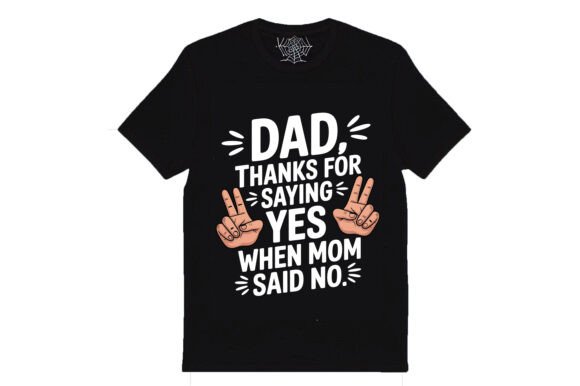
Dad, Thanks for Saying Yes When Mom Said
A Warm, Conversational Design—But Does It Stitch Well?
As someone who’s digitized, tested, and shipped hundreds of embroidery designs for small shops and Etsy sellers, I opened Dad, Thanks for Saying Yes when Mom Said expecting charm—and got it. The phrase lands like a quiet inside joke between generations: warm, slightly nostalgic, gently humorous. Visually, it reads as a clean, centered phrase design—no borders, no clipart, no overdesigned flourishes. That simplicity is its strength *and* its test.
Real-World Use: A Custom Embroidered Tote for Father’s Day Pop-Up
Last month, I prepped this design for a local boutique’s Father’s Day tote bag launch—cotton canvas, medium weight, natural beige. We stitched it on the front left chest area (about 4” wide) using a standard 5x7 hoop. Right away, the rhythm of the text stood out: “Dad” anchors it; “Thanks for saying yes when Mom said…” unfolds with breathing room between words. No cramming. No awkward line breaks. That spacing? Critical. It gave our satin-stitched letters enough isolation to stay crisp—even on a textured surface where dense fill stitches might blur.
Where It Shines
- Custom apparel: Works cleanly on crewnecks, relaxed tees, and lightweight sweatshirts—especially when paired with soft, matte thread (like Isacord or Madeira Polyneon).
- Personalized gifts: Feels heartfelt without being saccharine. Grandparents love it on baby blankets; new dads appreciate it on nursery pillows or kitchen towels.
- Small shop merchandise: As a T-Shirt Designs asset, it’s versatile in mockups—looks equally authentic on vintage cotton tees and modern unisex cuts.
- Embroidered patch potential: With minor cleanup (tightening kerning, simplifying serifs), it could translate beautifully to a sew-on or iron-on patch—ideal for dad-themed aprons or denim jackets.
Where to Proceed Thoughtfully
This isn’t a “drop-in-and-stitch” design for every scenario. Here’s what I watched closely:
- Hoop size & letter height: At default sizing, the tallest letter (“D”, “Y”, “M”) hits ~0.6” high. That means under 3” total height—but still too tall for tiny hoops (like 3x3). Avoid stitching it full-size on baby onesies unless you resize thoughtfully and re-digitize spacing.
- Textured or stretchy fabric: On ribbed knit tees or slubbed linen, the running stitch outlines held up well—but only with medium tear-away stabilizer underneath *and* light topping. Skip the topping on dark fabrics; it can mute contrast.
- Dark fabric contrast: Tested on navy cotton twill—black thread read clearly, but charcoal or navy thread didn’t. Always check your thread color against background tone *before* stitching the final piece.
- Curved surfaces: Tried it on a structured baseball cap front panel. The curve compressed the lower “d” and “s” slightly. Not a dealbreaker—but for caps, consider a version with slightly wider letter tracking or a simplified font variant.
What This Design Says About Your Brand—Before a Single Stitch
When customers see Dad, Thanks for Saying Yes when Mom Said on your handmade product, they’re not just reading words—they’re sensing intention. It signals warmth, authenticity, and emotional intelligence. That matters more than ever for Etsy sellers and craft fair vendors. Unlike generic “World’s Best Dad” graphics, this one invites recognition—not applause. Buyers pause. Smile. Say, “Oh—that’s *so* my dad.” That micro-moment builds trust, increases perceived value, and encourages repeat visits.
For commercial embroidery work, it also reinforces professionalism. Its clean layout means fewer client revisions. Its balanced negative space gives your stitching room to breathe—reducing thread breaks and stabilizer show-through. And because it leans into typography over illustration, it pairs effortlessly with subtle companion elements: a tiny stitched heart, a minimalist anchor, or even a monogrammed initial tucked beneath “Dad.”
Practical Designer Notes You’ll Want to Follow
Before adding Dad, Thanks for Saying Yes when Mom Said to your next project or digital shop inventory, here’s what I do—and recommend you do too:
- Test on scrap fabric first, especially if using textured weaves or blends. Note how satin stitch edges behave near curves and corners.
- Check stitch density in the word “Thanks”—the “T” and “h” have tighter intersections. Overly dense fill here can cause puckering on lightweight cotton.
- Review licensing terms carefully. The listing says these are digital files for yourself, friends, family, or anyone who supports your Sp—but “Sp” appears cut off. Clarify whether this permits resale of finished embroidered items or redistribution of the embroidery file itself before listing on Etsy or your own site.
- Use proper stabilizer: Medium-weight cut-away for knits; tear-away for stable wovens; fusible + topping for nap-heavy fabrics like fleece.
- Compare light/dark mockups—not just visually, but by stitching both. Thread sheen shifts dramatically depending on base color.
- Inspect small details in your embroidery software: Are all letters fully connected? Is there stray underlay? Does the “y” tail clear adjacent letters at reduced sizes?
Final Thought: A Quiet Standout in a Noisy Category
In a sea of bold, graphic-heavy T-Shirt Designs, Dad, Thanks for Saying Yes when Mom Said stands out by leaning in—not shouting. It’s not flashy. It doesn’t need glitter or gradients. What it delivers is clarity, sincerity, and real-world embroidery resilience. For makers building a reputation on quality and emotional resonance—not just speed or scale—this is the kind of graphics asset that earns repeat orders, heartfelt tags on Instagram, and notes in customer thank-you cards. Just remember: respect its rhythm, honor its context, and always—*always*—test before you commit.